user experience research, user experience design,
communication design, low/medium fidelity prototyping
How might we encourage mental health support focused on long-term and ongoing care?
While the stigma surrounding the topic of mental health is slowly diminishing, issues surrounding mental health support within post-secondary institutions in Ontario remain. Post-secondary institutions across Ontario offer varying levels of mental health support and treatment options for their students that range from distinctive to generic services. Yet, students are met with numerous barriers when trying to access meaningful care, from untimely support, to a misunderstanding of expectations from treatment, to a lack of empathetic solutions.
Based on our insights, we re-framed the current reactive Health & Wellness Centre model found in Ontario post-secondary institutions and transformed it into a proactive wellness solution called the Student Wellness Network.
The Mental Health team consists of myself, Lydia Notten, Victoria Yue Shi, Hailen Xu, and with guidance and in conjunction with eCampusOntario's SXD Lab. I was involved in every stage: from research, interviewing, transcription, analysis, prototyping, copy editing, graphic design, and the final report's design.
Research Methods
Interviews
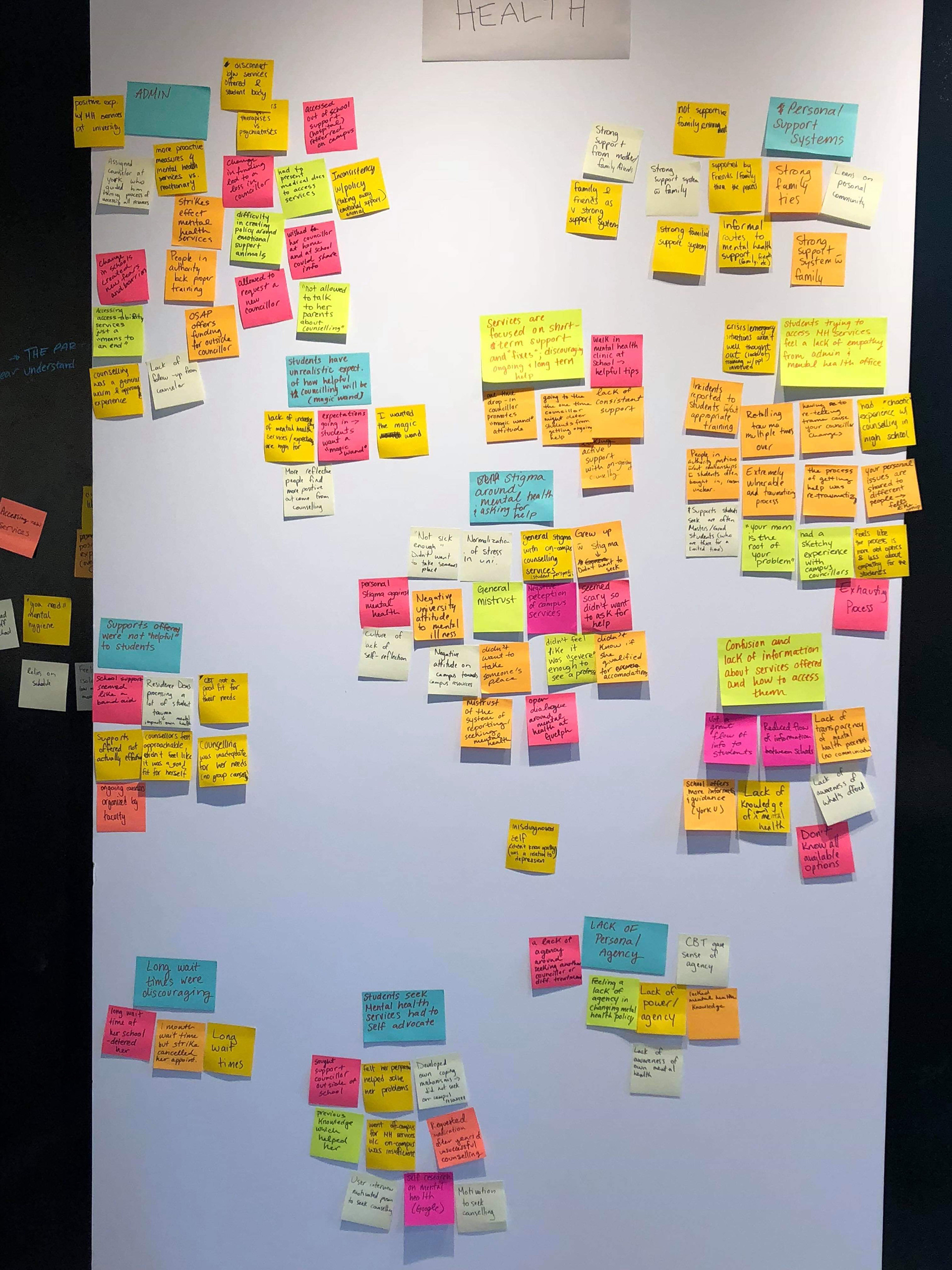
We conducted in-depth interviews with 19 students from varied institutions across Ontario who had accessed mental health services on their campus and/or struggled with their mental health during their post-secondary career. Participants were asked about their experiences with their own mental health struggles, as well as their process of accessing mental health resources.
Journey maps
To gain a stronger sense of the process of accessing care on campus, each member of our team went through the process of accessing mental health on each of our respective campuses (University of Toronto, University of Waterloo, OCADu) and mapped out what that process looked like. We looked for key themes and pain points across these institutions.
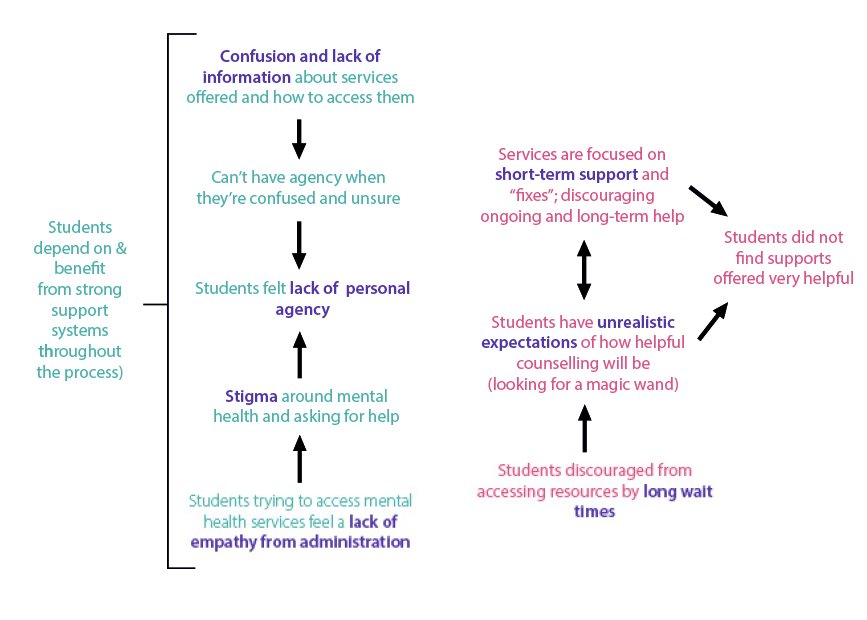
Difficulties & Frustrations Within the System
Solution: The Student Wellness Network
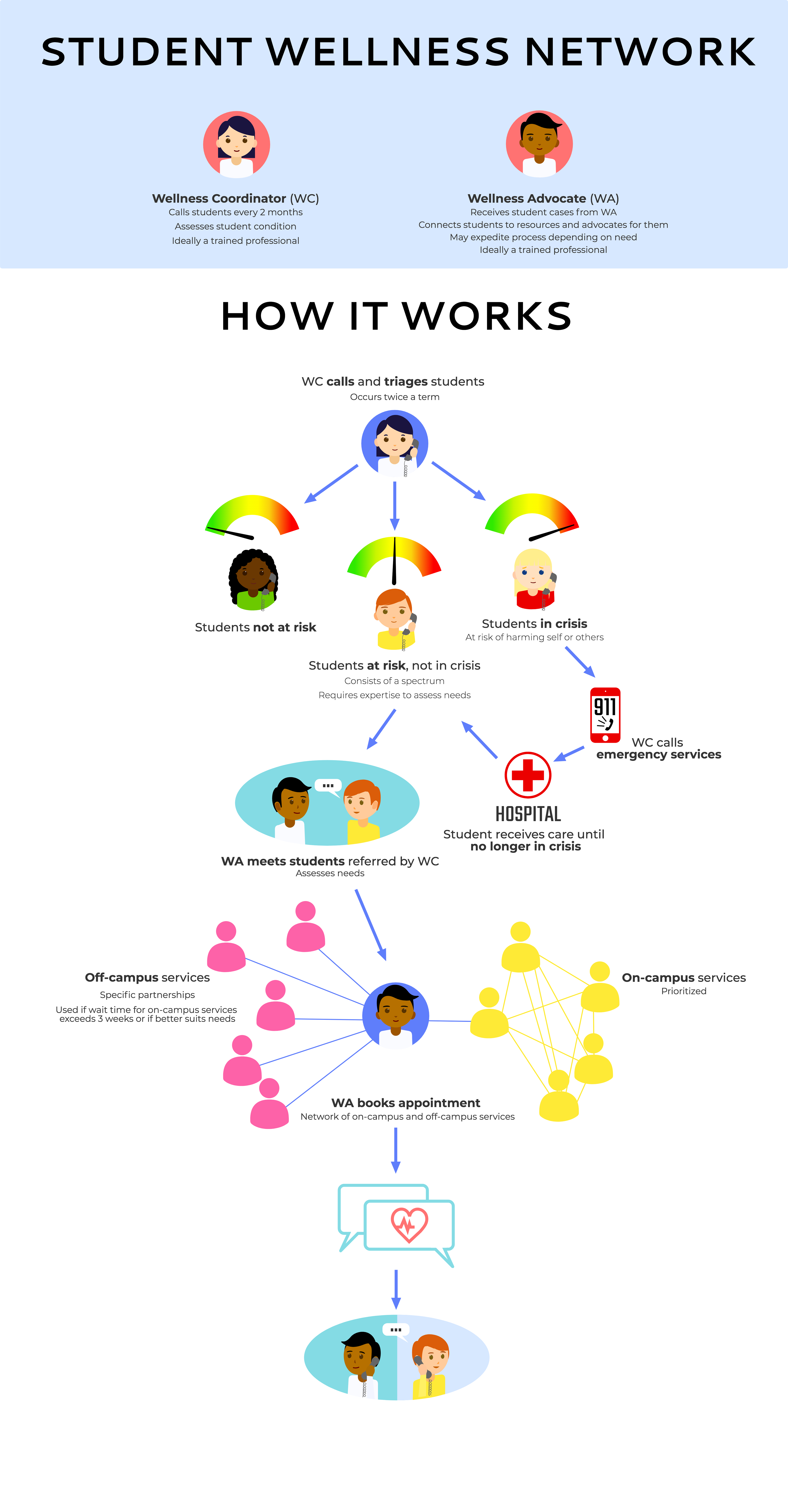
With encouraging long-term care in mind, our solution is a system that aims to support students throughout their post-secondary career by easing the burden of self-advocacy in a system that may often seem confusing. The Student Wellness Network team consists of 2 roles: a Wellness Coordinator (WC) and a Wellness Advocate (WA). Each of them support student before, during, and after accessing care, with different requirements of each. They both are knowledgeable about available services within the school as well as within the local community. solution 6 The Student Wellness Network’s goal is to proactively and empathetically ensure the well-being of post-secondary students. This is achieved through the WC calling all students on a reoccurring, 2-3 month basis, followed by a closer assessment of well-being by the WA.
Next Steps: Future funding, consultation, pilot
Our system will yield benefits for both students and administration. The network aims
to decrease the stigma associated with seeking mental health support, as well as
reduce the confusion associated with navigating existing systems. The Student Wellness
Network would reduce wait times for students seeking treatment by making the
process more streamlined, and aims to improve the overall mental health of the student
body. For administration, our system bridges the gap between on-campus and
off-campus services and moderates the workload of on-campus wellness services.
to decrease the stigma associated with seeking mental health support, as well as
reduce the confusion associated with navigating existing systems. The Student Wellness
Network would reduce wait times for students seeking treatment by making the
process more streamlined, and aims to improve the overall mental health of the student
body. For administration, our system bridges the gap between on-campus and
off-campus services and moderates the workload of on-campus wellness services.
This project requires further consultation with post-secondary administration: while our team did consult with some administration at Ontario institutions, we would recommend inviting further feedback from administration going forward. In order to measure the network’s success, a long-term pilot project is suggested, as well as conducting deeper research in the form of a literature review from scholars and professionals within the education and mental health spaces.